Clinical Care Navigator
A patient-facing assistant that is allowed to refuse.
An assistant that explains a patient's own record, with independent safety checks before and after the AI. Dosing questions are refused, emergencies get urgent guidance, and answers that conflict with the record — such as a critical lab value — are overridden and sent to a clinician.
- canonical eval cases gating every PR
- 16
- passed on the last live-model run
- 16 / 16
- Playwright browser specs
- 11
Why it exists
A patient reads a lab result in their portal and does not understand it: “My A1c came back 7.8 — what does that mean?” An assistant that explains it is genuinely useful. An assistant that answers everything is a liability, because the same box will also receive “should I stop taking my metformin?”, “do I have lupus?” and “I have crushing chest pain.”
Most healthcare AI demos put a disclaimer in the system prompt and call it safety. That is hard to test, easy to bypass and impossible to measure. A healthcare organization needs the opposite: safety rules that sit outside the model, have their own tests and publish their own numbers — so that a clinical owner, not the model vendor, decides how cautious the assistant should be.
How it works
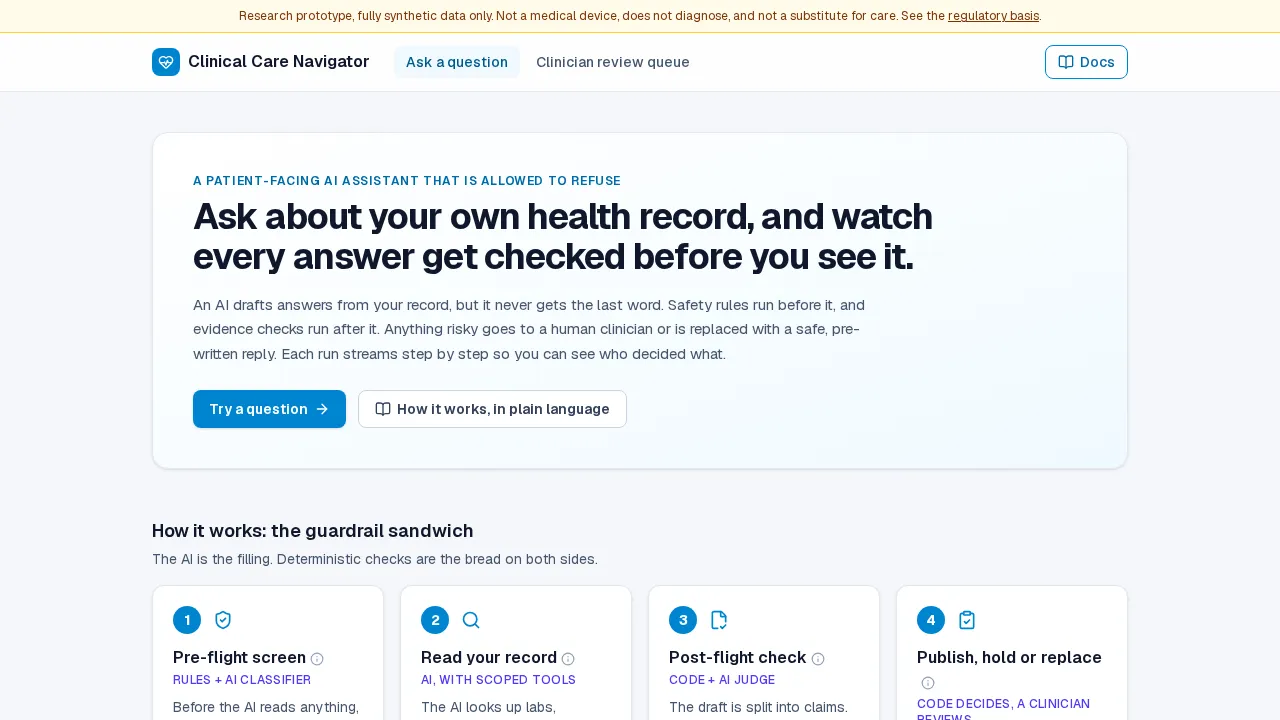
Policy runs before the model and again after it — a guardrail sandwich. The second half is not a replay of the first; it judges the retrieved evidence and the drafted answer on its own authority.
- 01 Input Patient question
- 02 Check Pre-flight screen rules + classifier
- 03 Model / AI Read the record scoped, read-only tools
- 04 Check Post-flight check claims must match the record
- 05 Code Publish, hold or replace
- 06 Human Clinician review if held
- Pre-flight screen: emergencies and decisions only a clinician can make are stopped before the AI reads anything.
- Read the record: the model looks up labs, medications and conditions for the selected patient only.
- Post-flight check: the draft is split into claims; each clinical claim must resolve to something actually retrieved, and critical values override the draft.
- Publish, hold or replace: code — not the AI — publishes the answer, holds it for a clinician, or swaps in a safe pre-written reply.
Why two independent halves
Take “What does my potassium of 6.9 mean?” It is a benign education question, so the pre-flight screen correctly allows it. But the retrieved value is above the critical-high threshold — a medical emergency — and only the post-flight half can know that. It overrides the draft with an urgent safety message and routes the case to clinician review. A single up-front filter cannot do this.
Results and honest limits
- Gating every pull request: a canonical evaluation of 16 cases (18 runs) that needs no model key, plus lint, strict typing, import contracts and tests.
- Live-model check: the same 16 cases passed 16 of 16 against the real model on the last run.
Engineering decisions
- A refusal never reaches a patient tool. This is enforced by the shape of the graph, not by a check inside a node.
- Substring matching is not a guardrail. A metaphor can defeat a keyword filter and an attributed mention must not trigger one, so classification is explicit and tested against both failure modes.
- Publication is deterministic. Final text is chosen by code from approved outcomes after the checks pass.
- Citations are real. Education links point to public-domain National Library of Medicine sources, and lookups use exact matching before semantic search.
- Every answer shows its work. Held answers wait in a durable queue and resume when a clinician decides, and the interface streams a step-by-step timeline with a per-node model and cost meter.
Who it’s for
For health systems and digital-health teams, it is a pattern for patient-facing AI where the clinical owner controls the boundaries. For engineering leaders, it shows how to turn “the model should be careful” into components you can test and measure.