RxFlow Pharmacy Assistant
A refill assistant that knows when a doctor or pharmacist has to step in.
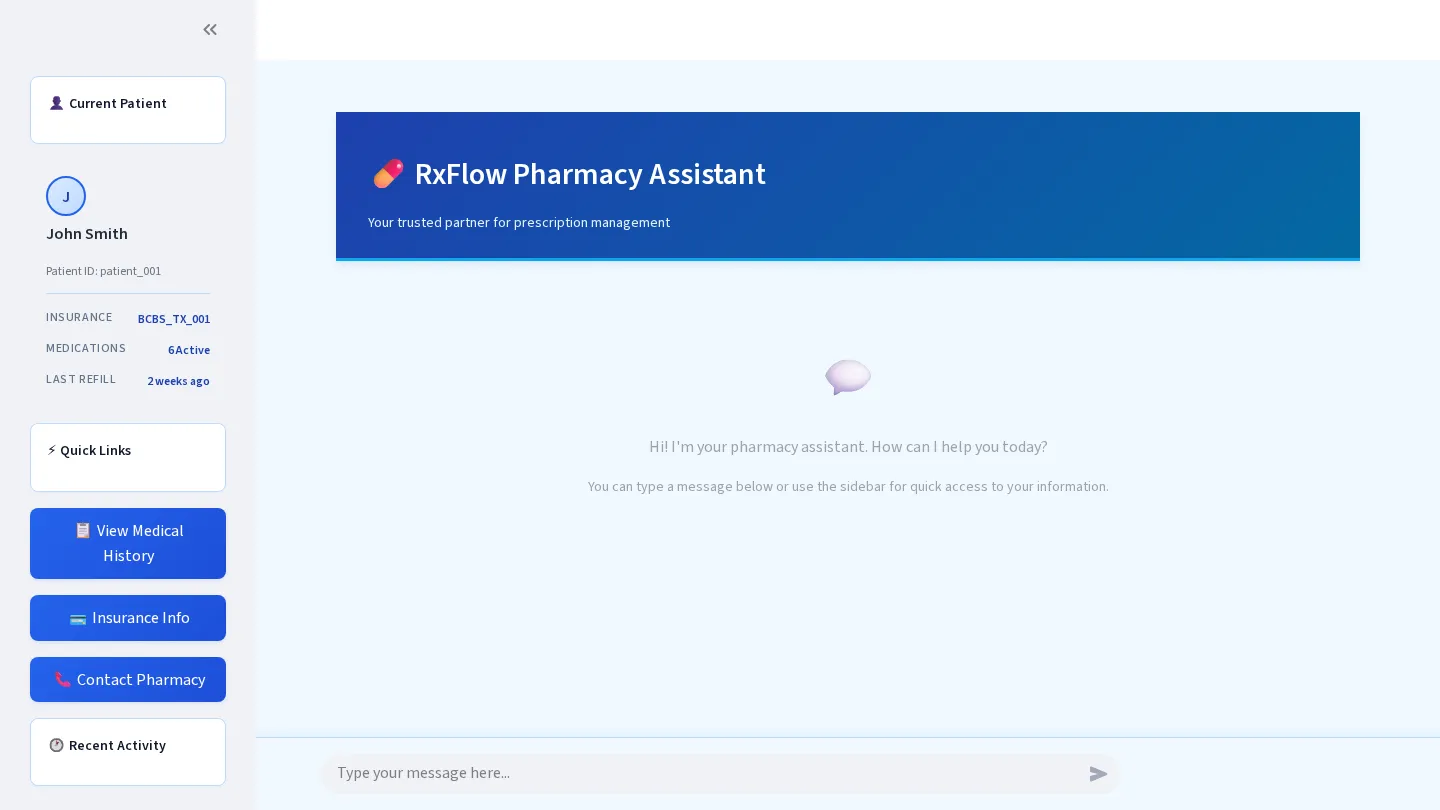
A conversational prescription-refill assistant built on a 10-state workflow and a LangChain agent with 16+ tools. Controlled substances, expired prescriptions and unknown medications are routed to a doctor or pharmacist instead of being handled by the AI.
- workflow states with explicit transitions
- 10
- specialized tools
- 16+
- escalation scenarios passing
- 5 / 5
- end-to-end workflow scenarios tested
- 8
Why it exists
Prescription refills look routine, and most of them are. The hard part is the minority that are not: a controlled substance, a prescription with no refills left, an expired script, a medication the system does not recognize, a store that is out of stock. A refill assistant earns its keep by handling the routine cases end to end — and by recognizing the others and handing them to the right professional.
RxFlow explores that boundary. The conversation is driven by an LLM agent, but the workflow it moves through, and the decision to escalate, are explicit and testable.
How it works
- 01 Input Patient request "Refill my medication"
- 02 Model / AI Identify & clarify medication patient history, RxNorm lookup
- 03 Check Safety & coverage checks dosage, interactions, allergies, formulary
- 04 Code Escalation routing doctor or pharmacist
- 05 Code Pharmacy & order fallback if out of stock
- 06 Human Doctor / pharmacist for escalated cases
- A 10-state workflow — from identifying the medication through confirmation and order submission — defines what can happen next at every step, with conditional transitions and error recovery. The agent converses; the state machine keeps the process on rails.
- A LangChain agent with 16+ tools handles patient history, RxNorm lookups, adherence, dosage validation, interaction and allergy screening, insurance formulary and prior-authorization checks, cost comparison and order management.
- Medical escalation is explicit. Controlled substances, expired prescriptions and zero-refill scripts route to a doctor; unknown medications and verification questions route to a pharmacist.
- Pharmacy fallback retries across stores in a defined order when a medication is out of stock, instead of failing the request.
- Multiple model providers (OpenAI, Anthropic, or a local model via Ollama) sit behind the same interface.
Results and honest limits
- Escalation: all 5 escalation scenarios — including controlled-substance detection and pharmacy fallback — pass.
- Workflow coverage: integration tests exercise 8 end-to-end workflow scenarios, including edge cases and failure modes.
- Delivery: a Streamlit interface, Docker deployment and a documentation site covering user, developer and deployment guides.
Engineering decisions
- State machine plus agent, rather than an agent alone: the LLM handles language, while the process and its allowed transitions are deterministic and inspectable.
- Escalation as a first-class outcome, with its own routing rules and logging, not as an error path.
- Tools over free text: clinical and coverage checks are tool calls with structured results the workflow can act on.
- Provider-agnostic model layer, so the same workflow can run on a hosted or a local model.
Who it’s for
For pharmacy and digital-health teams, it shows how to automate the routine path of a regulated workflow while making the hand-off to professionals explicit. For engineering leaders, it is a compact example of pairing a conversational agent with a deterministic process model.