Credit Decisioning
Adverse-action notices that are verified before anyone sends them.
A calibrated credit model, notices written by code from a reviewed template, an independent eight-check verifier proven by mutation testing, and a human who makes the call. A read-only AI analyst explains cases — and code checks every number it states.
- mutation classes caught
- 14
- genuine notices wrongly rejected (of 1,006)
- 0
- AUROC, out-of-fold
- 0.780
- analyst guardrail cases pass
- 19 / 19
Why it exists
In the United States, ECOA and Regulation B require a written notice with the principal reasons when credit is declined. “Insufficient score” is explicitly not enough, and the CFPB has said the duty is the same when a complex model makes the decision. In practice, two things go wrong:
- Reasons drift from what the model used — after a template edit, a mapping change or a reviewer’s rewording.
- Generated text adds things nobody checked — a wrong number, a promise, or a prohibited basis such as age or sex.
The applicant cannot contest a reason they were never given, and the lender carries the regulatory exposure. The project asks a practical question: how do you prove a regulated document is correct before it is sent?
How it works
- 01 Input Application
- 02 Model / AI Calibrated model probability of a bad outcome
- 03 Code Policy band & reasons derived from the cost matrix
- 04 Code Notice from template
- 05 Check Eight-check verifier independent implementation
- 06 Human Reviewer decides
Every artifact has a producer and a separate check:
| Artifact | Produced by | Checked by |
|---|---|---|
| Probability of a bad outcome | Calibrated logistic regression | Repeated 5×5 cross-validation, bootstrap intervals, reliability curve |
| Approve / refer / decline band | Code, from the benchmark’s cost matrix | Unit tests pin the derived (not tuned) threshold |
| Principal reasons | Code, from the model’s coefficients | Attributions must sum to the model’s log-odds difference |
| Notice text | Code, from a reviewed template | Eight deterministic verifier checks |
| Analyst answers | A read-only LLM agent | Code checks every number against tool results |
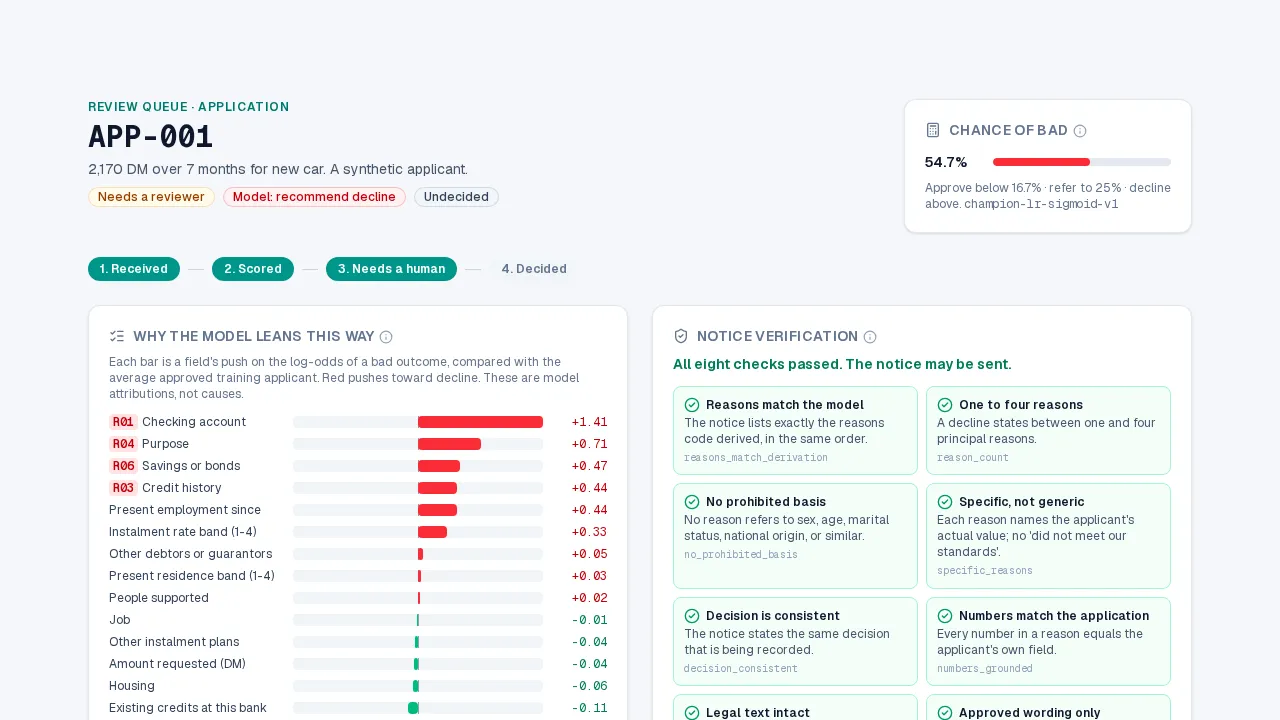
A reviewer sees the model’s reasons, the verifier’s results and the drafted notice, then records the decision. The model’s recommendation stays on record even when the human overrides it.
The verifier is itself verified
The verifier is a second, independent implementation — it never calls the renderer. It checks that reasons match the derivation, that there are one to four of them, that none rests on a prohibited basis, that each states the applicant’s actual value, that the decision is consistent, that every number matches the application, that the legal text matches a pinned hash, and that each sentence is approved wording.
To prove those checks earn their place, a mutation suite applies 14 kinds of defect to every genuine notice and requires each one to fail its intended check. A meta-test then switches each of the eight checks off in turn and requires the gate to notice.
Results and honest limits
All figures come from one generated run (2026-10-29) on the benchmark’s 1,000 applicants with out-of-fold predictions.
- Decision quality: expected cost of 0.541 per applicant (95% interval 0.488–0.598) against 0.70 for declining everyone — the right baseline, because declining a good applicant costs 1 and approving a bad one costs 5. AUROC is 0.780 (0.751–0.810).
- Model choice: a boosted-tree challenger gained +0.012 AUROC with an interval that includes zero, so the simpler, explainable model was kept.
- Verifier: every applicable mutant was caught across 1,006 genuine notices, no genuine notice was rejected, and all eight checks were detected when disabled.
- Analyst agent: 19 of 19 scripted guardrail cases pass. A separate live run of 15 questions behaved correctly on all 15 after fixes, with one answer flagged for a real transcription error — a smoke test, not a rate.
Engineering decisions
- No LLM on the decision path, enforced by an import contract rather than by convention.
- The review workflow is a plain state machine with atomic claims — a double start or a stale page returns a conflict — and a verified-hash binding before a notice can be sent.
- Reproducible by construction: pinned, hash-checked data, and a single command that retrains from scratch and requires the evidence to match.
- Quality gates on every pull request: lint, strict typing, import contracts, 90%+ test coverage and an evaluation gate.
Who it’s for
For lenders and fintech teams, it shows an approach to regulated, explainable decisions where every outbound document is independently verified. For AI and risk leaders, it is a worked example of using mutation testing to prove that your safety checks actually catch failures.