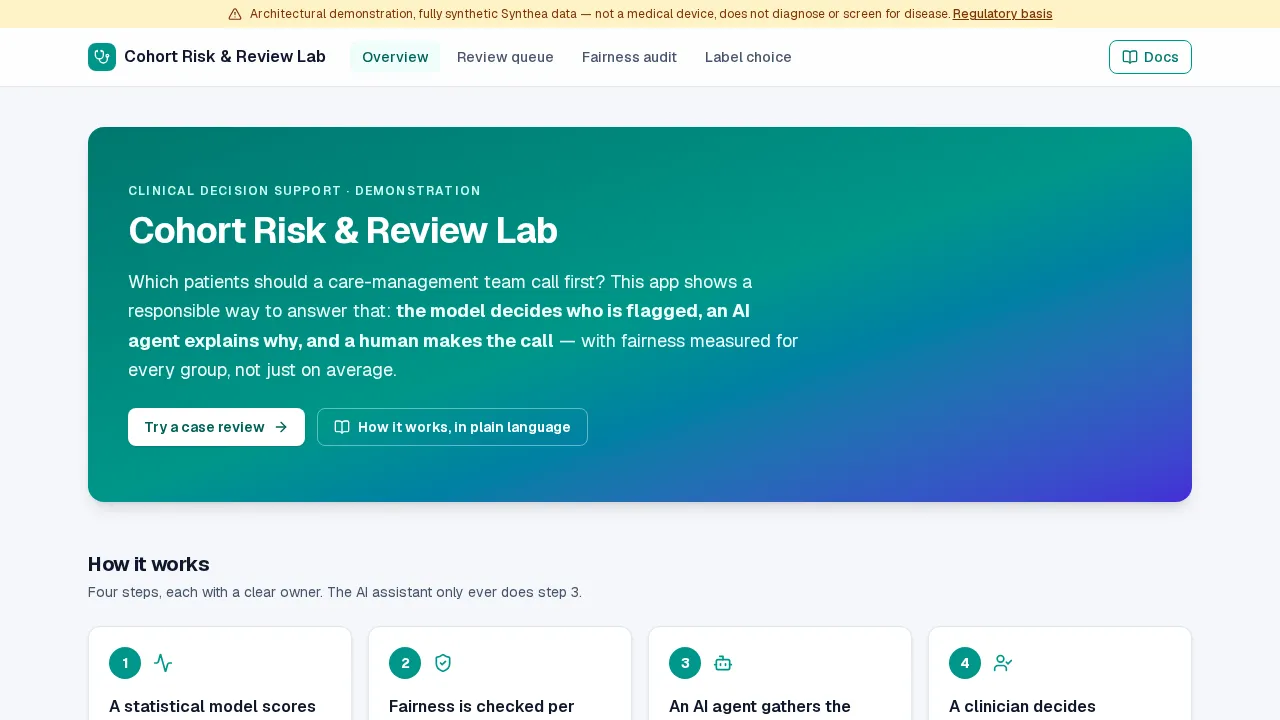
Cohort Risk & Review Lab
Patient risk stratification that is fair by measurement, not by assumption.
A calibrated risk model decides who is flagged, fairness is audited for every subgroup, an AI agent assembles the evidence, and a clinician makes every enrolment decision. It also reproduces how training on cost instead of illness burden skews who gets care.
- flagged patients in the review queue
- 19,409
- enrolment gap from the label-choice experiment
- 5.7 pts
- subgroup axes audited with confidence intervals
- 4
Why it exists
A care-management team can only call so many patients. Deciding who to call first is a ranking problem, and the most dangerous failure is a model that looks accurate on average while quietly under-serving one group.
Two things go wrong in practice. First, a score is often trained on a convenient label such as future cost when the real goal is future need. Groups that face barriers to care generate less cost for the same illness, so they are ranked as lower risk — the label-choice failure documented by Obermeyer et al. (Science, 2019). Second, a single overall accuracy figure hides the groups where the model performs badly.
The goal was a pipeline where both failures are measured and visible, and where no automated component can enrol a patient on its own.
How it works
- 01 Input Patient record
- 02 Model / AI Calibrated risk model never sees race
- 03 Check Per-subgroup fairness audit age, sex, race, insurance
- 04 Model / AI Evidence brief read-only tools, cannot change the score
- 05 Human Clinician decides enrol, decline or defer
Each step has a clear owner:
- A calibrated model scores every patient. A statistical model — not a chatbot — estimates each patient’s chance of a high illness burden.
- Fairness is audited per group. Calibration and true-positive-rate parity are reported across age, sex, race and insurance strata with confidence intervals. Strata with too few patients show “insufficient data” instead of a misleading number.
- An AI agent assembles the evidence. For each flagged patient it gathers encounters, labs and care gaps into a short brief: drivers, corroborating evidence and what is missing. It cannot change the score or recommend enrolment.
- A clinician decides. Nothing happens to a patient without that decision.
The label-choice experiment
The most instructive part of the app is a single interactive artifact: two otherwise identical models, one trained to predict cost and one trained to predict illness burden. On this synthetic cohort, which has a deliberately injected access gap, the cost-trained model enrols Black patients at a lower rate — a 5.7 percentage-point gap between the two labels. It demonstrates the mechanism on controlled data; it is not a finding about any real health system.
Results and honest limits
- Gated in CI: a validation harness fits both models on a frozen, race-stratified sample of the generated cohort and requires AUROC and calibration floors, correct small-sample handling, and that the label-choice gap never silently regresses to zero.
- Scenario tests: four hand-authored patients exercise the care-gap tools — including one with no recorded history, where every evidence category must be reported as missing.
- Full-stack delivery: a review queue of 19,409 flagged patients, case pages, the fairness audit and the label-choice chart, served by a persistent API and a Next.js interface covered by Playwright browser tests.
Engineering decisions
- Model and agent are separated by contract. The risk pipeline — features, calibration, thresholds, fairness audit — may not import any LLM framework, and an import-linter rule enforces it in CI.
- Typed tools, not text-to-SQL. The agent can only call a fixed set of read-only evidence tools, so its reach into patient data is bounded and testable.
- Human review is a real graph interrupt. The case flow suspends at the decision step and resumes through the API once a clinician decides, with a streaming trace of each step.
- No fabricated numbers. Below the minimum sample size, the audit reports a subgroup as missing rather than computing a statistic from a handful of patients.
Who it’s for
For health systems and payers, it shows how to put a risk model, a fairness audit and a human reviewer into one auditable workflow. For teams evaluating AI in regulated settings, it shows how to keep an LLM useful while keeping it out of the decision path.