Architecture overview
In one paragraph, for a non-engineer
The system is a small state machine. Each box does one job and hands its result to the next. Two of the boxes are safety checks — one before the assistant reads anything, one after it has written a draft — and the boxes that make the final decisions are ordinary code, not the language model.
The graph
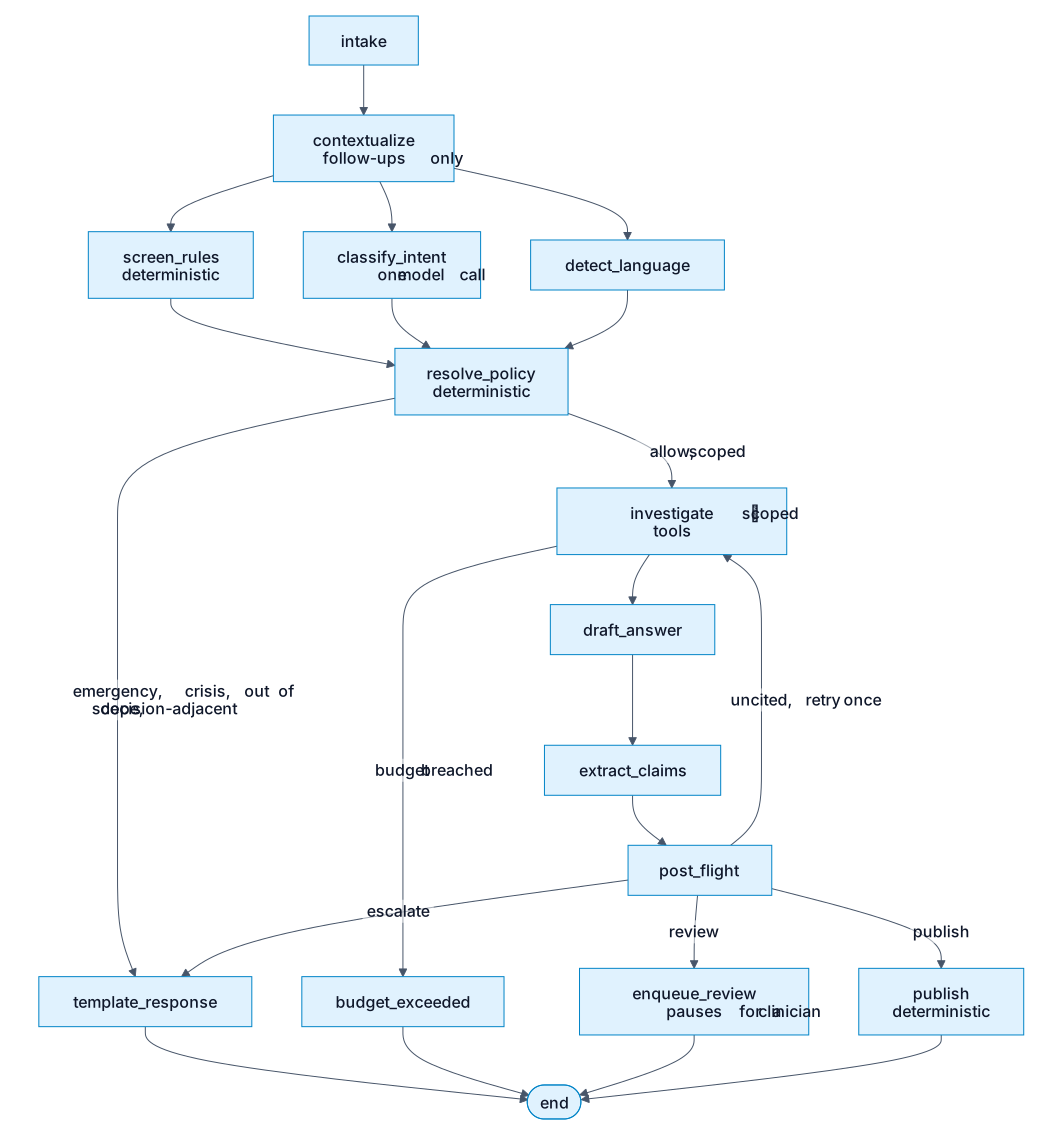
Five properties this is designed to have
- Both halves of the sandwich assess independently. Pre-flight judges the question; post-flight judges the evidence and the answer.
- Refusal short-circuits before any patient data is read. Minimum necessary is enforced by topology, not by filtering afterwards.
- One model call before any evidence is gathered.
screen_rulesandresolve_policyare code. Don't spend a model call on a decision anifcan make. (A follow-up question adds one cheap call first,contextualize, to make it stand on its own; a first question never pays for it. See Follow-up questions.) - Cheap checks run before expensive ones. Critical-value and citation checks are pure code and can short-circuit the judge.
- Publication is deterministic.
publishemits the already-judged draft; it contains no model call and cannot alter the text.
Conventions
- The node filename equals the registered node name equals the trace span name.
builder.pyis the only file that wires nodes and edges, so the whole control flow reads in one screen.- Nodes orchestrate, chains compute, agents decide. Each node receives a narrow read-only projection of state, not the whole blob.
- Prompts are versioned files referenced by id, never string literals in logic.
Layering is enforced in CI by import-linter:
api → graph → guardrails → tools → retrieval → store → schemas.